The church is bursting with suffering souls. People come to the church for help but even in our culture Depression is misunderstood. I want to do something to help. I see myself becoming more equipped for soul care within the church body.

Showing posts with label Depression. Show all posts
Showing posts with label Depression. Show all posts
Monday, March 09, 2009
Depression in Christianity Today
Wow! What a great package in Christianity Today on Depression. I think it does a great job highlighting the complexities of Depression.

Thursday, July 26, 2007
David Powlison Discusses Depression
The Albert Mohler Radio Program recently featured a discussion with David Powlison about the darkness of depression. The discussion is insightful, biblically accurate, and filled with humility. I highly recommend setting aside some time to listen and grow in your understanding of depression.
Monday, July 16, 2007
Resource for the Depressed and Those Who Love Them
I am pleased to have recently discovered a few audio resources on depression. I do a lot of reading on the topic and had become somewhat disinterested (i.e. brain burnout) so I went on the hunt for human voices.
Back in early 2006 FamilyLife Today radio ran a few broadcasts with Ed Welch. Welch is one of my favorite authorities on depression because he is like no other in the way he speaks biblical truth (and he is educated in Clinical Psychology ). He also is the author of a fantastic book, Depression: A Stubborn darkness - A Light for the Path.
These broadcasts assist both the depressed and those who love them:
What is Depression?
Suffering Well
Help for the Depressed
Strategies for Dealing with Depression
Back in early 2006 FamilyLife Today radio ran a few broadcasts with Ed Welch. Welch is one of my favorite authorities on depression because he is like no other in the way he speaks biblical truth (and he is educated in Clinical Psychology ). He also is the author of a fantastic book, Depression: A Stubborn darkness - A Light for the Path.
These broadcasts assist both the depressed and those who love them:
What is Depression?
Suffering Well
Help for the Depressed
Strategies for Dealing with Depression
Friday, March 23, 2007
A Sermon for Joy in Christ
Tim Porter, Pastor at Faith Community Church in Hudson, WI preached an outstanding sermon on John 16:16-33 last Sunday.
If you suffer with hopelessness, the heart issue of all joylessness, or know someone who does, then please set aside a half hour to listen to this sermon. This is a sermon of real hope. Click here.
If you suffer with hopelessness, the heart issue of all joylessness, or know someone who does, then please set aside a half hour to listen to this sermon. This is a sermon of real hope. Click here.
Tuesday, February 27, 2007
Do the Next Thing
I often poke fun at a few pat answers I've picked up over my life when dealing with life's difficulties:
I had forgotten about another phrase I used to say: "Just Do the Next Thing" In a sense this phrase is similar to "just keep plugging away" but I've always thought "doing the next thing" to be more helpful. I wonder why I stopped speaking this to myself?
Thankfully though I read this post first thing this morning. Then I found this poem:
BTW, be sure to read this fantastic review of Piper's When the Darkness Will Not Lift.
- "It is what it is"
- "Could be worse"
- "Just keep plugging away"
I had forgotten about another phrase I used to say: "Just Do the Next Thing" In a sense this phrase is similar to "just keep plugging away" but I've always thought "doing the next thing" to be more helpful. I wonder why I stopped speaking this to myself?
Thankfully though I read this post first thing this morning. Then I found this poem:
Doe the Nexte ThyngeWhen the darkness does not lift, do the next thing.
(author unknown)
From an old English parsonage down by the sea
There came in the twilight a message to me;
Its quaint Saxon legend, deeply engraven,
Hath, it seems to me, teaching from Heaven.
And on through the doors the quiet words ring
Like a low inspiration: “DO THE NEXT THING.”
Many a questioning, many a fear,
Many a doubt, hath its quieting here.
Moment by moment, let down from Heaven,
Time, opportunity, and guidance are given.
Fear not tomorrows, child of the King,
Trust them with Jesus, do the next thing
Do it immediately, do it with prayer;
Do it reliantly, casting all care;
Do it with reverence, tracing His hand
Who placed it before thee with earnest command.
Stayed on Omnipotence, safe 'neath His wing,
Leave all results, do the next thing
Looking for Jesus, ever serener,
Working or suffering, be thy demeanor;
In His dear presence, the rest of His calm,
The light of His countenance be thy psalm,
Strong in His faithfulness, praise and sing.
Then, as He beckons thee, do the next thing.
BTW, be sure to read this fantastic review of Piper's When the Darkness Will Not Lift.
Wednesday, February 21, 2007
America's Anger Expert
Found this gem of a resource yesterday: America's Anger Expert (Dr. Les Carter)
I like the website because it is practical in helping process through the spectrum of thoughts and feelings that appear with out of control anger. But most of the material falls short of the heart of the matter, literally. Anger is ultimately about God. My worst relationship where anger is present reveals my heart before God. Resources like America's Anger Expert are good for examining how anger manifests itself in specific attitudes and behaviors. These attitudes and behaviors should point out idolatry and sin. When my heart is sliced and layed open by anger exposing death and destruction, what hope is there? Jesus!
Finding Anger
The following questions, from Dr. Carter's website, are useful in pointing out the idolatry that is at the heart of anger:
I like the website because it is practical in helping process through the spectrum of thoughts and feelings that appear with out of control anger. But most of the material falls short of the heart of the matter, literally. Anger is ultimately about God. My worst relationship where anger is present reveals my heart before God. Resources like America's Anger Expert are good for examining how anger manifests itself in specific attitudes and behaviors. These attitudes and behaviors should point out idolatry and sin. When my heart is sliced and layed open by anger exposing death and destruction, what hope is there? Jesus!
Finding Anger
The following questions, from Dr. Carter's website, are useful in pointing out the idolatry that is at the heart of anger:
"Think carefully what your anger is wishing to convey. Your anger is connected to your sense of self-preservation. Specifically you are wishing to preserve one of three things:
- Your worth as a human. ("Would you please show me some respect?")
- Your legitimate needs. ("Would you recognize that I have needs that should be tended to"?)
- Your deepest convictions. ("I have certain beliefs I will not back down from.")
- Think about the legitimacy of this self-preservation. Can you recognize that anger can have a valid function?"
Monday, February 19, 2007
Anger Quotes
Depression and Anger
"The most concise definition I know is this: "Depression is frozen rage." If you have a consistently serious problem with depression, you have not resolved some area of anger in your life. As surely as the night follows day, depression follows unresolved, repressed, or improperly expressed anger. Healing for Damaged Emotions, David A. Seamands, 1991, page 125Anger is imitation
"Anger is always a form of imitation. Either we are imitating the way mercy trumps anger in the character of Jesus, or we are mimicking the destructive anger of Satan (John 8:44) There are no choices." Depression A Stubborn Darkness Light for the Path, Edward T. Welch, 2004, page 160Injustice, Unbalanced Anger, and Depression
"Perfectionists have a very deep disproportionate sense of justice and injustices. They feel a deep need to right the wrongs of the world, to correct things, to pull up the weeds that are growing with the wheat. Now, that feeling is valuable; it exists in every reformer, in every preacher and missionary; and to some degree it should in every Christian. That sense of injustice surrendered, cleansed, and controlled by the Holy Spirit can be a useful instrument in the hands of God 'for spreading scriptural holiness and reforming the nation," as John Wesley said. But out of hand, out of balance, with the anger problem behind it unresolved, the sense of injustice is very destructive, producing depression and disrupting good personal relationships." Healing for Damaged Emotions, David A. Seamands, 1991, page 125
Friday, February 16, 2007
Anger in the image of God
All of life needs to be considered from the top down. I am learning the more I live the more nothing makes sense unless it is considered starting first with the big picture, grand story of God and His Kingdom. What I mean is life's most annoying problems can be dealt with better in light of God's unfolding drama. The story seems to infuse meaning into all of life's struggles. Is it weird to thank God for my struggles because without them I would not know Christ?
Paul Tripp does a fantastic job in this lecture: "Anger is one of God's most beautiful charactaristics" (The link actually takes you to Tripp's ministry home page. The video is on the home page.)
The big take-away for me: two angers are at war with each other - Man's vs. God's, yet man imitates God when acting in the image of His anger. Most people speak of God's love. But does God's love mean anything without God's anger? You'll have to watch the video to know why I am questioning. Interesting.
(PS - Another, more personal, look at God's anger here: Sinners in The Hands of an Angry God. Believe, it is much more personal...hopefully it is...at least it better be.)
Paul Tripp does a fantastic job in this lecture: "Anger is one of God's most beautiful charactaristics" (The link actually takes you to Tripp's ministry home page. The video is on the home page.)
The big take-away for me: two angers are at war with each other - Man's vs. God's, yet man imitates God when acting in the image of His anger. Most people speak of God's love. But does God's love mean anything without God's anger? You'll have to watch the video to know why I am questioning. Interesting.
(PS - Another, more personal, look at God's anger here: Sinners in The Hands of an Angry God. Believe, it is much more personal...hopefully it is...at least it better be.)
Monday, February 05, 2007
Series on Anger
"Fear is the most obvious co-conspirator with depression; anger is the most common. The formula is a simple one: Sadness + Anger = Depression" Depression A Stubborn Darkness, Edward T. Welch, page 153
"Anger will not always be the cause of your depression, although some researchers want to tell you that it is a likely cause. But anger is frequently revealed by depression. The wisest way to approach this subject is to assume you are angry." Welch, page 154
If I blog much at all in the next few months the topic will be on Anger.
Friday, January 26, 2007
Anitdepressent Medication
One of iMonk's recent post looks at answering the question: What About Antidepresent Medication? The post is balanced and shows how biblical wisdom in every personal experience must not be overlooked. I always appreciate iMonk's personal flair in his posts. The comments section on this recent post should be good so stay tuned.
Friday, December 15, 2006
Fighting Depression, Fighting For Joy
A few posts ago I made reference to a personal list of the top 20 (or so) items I must maintain in my life in order to battle depression. As I stated, based on experience, I know I need to have these items fully implemented in my life before anti-depressant medication is "needed."
The number one item on the list is a grace-infused resolve to fight and persevere through the dark times. The fight of depression is really a fight for joy. I am not talking about willing myself to feel better. I mean that the fight for joy starts with faith in God's grace and sovereign control over all of life, and this includes emotions. In His sovereign plan, fighting through depression is to be part of my life. Notice here too that I did not say living in depression is to be part of my life. But, the grace and mercy supplied by God while fighting with depression is the means by which I become more like Jesus. This is just something I have come to learn and accept about the really dark times of my life. God alone be praised!
John Piper has been helpful to me with this idea. I learned today that he has a new book out that looks like it will provide practical help with the fight - When Darkness Will not Lift - Doing What We Can While We Wait for God -- and Joy.
The number one item on the list is a grace-infused resolve to fight and persevere through the dark times. The fight of depression is really a fight for joy. I am not talking about willing myself to feel better. I mean that the fight for joy starts with faith in God's grace and sovereign control over all of life, and this includes emotions. In His sovereign plan, fighting through depression is to be part of my life. Notice here too that I did not say living in depression is to be part of my life. But, the grace and mercy supplied by God while fighting with depression is the means by which I become more like Jesus. This is just something I have come to learn and accept about the really dark times of my life. God alone be praised!
John Piper has been helpful to me with this idea. I learned today that he has a new book out that looks like it will provide practical help with the fight - When Darkness Will not Lift - Doing What We Can While We Wait for God -- and Joy.
Monday, November 27, 2006
Children Enslaved by Psychiatric Labels
The Christian Mind blog comments on an article in the New York Times on children and biopsychiatry.
Link to article: What's Wrong With a Child?
Here is a statement from the commentary that I agree with 100%:
Link to article: What's Wrong With a Child?
Here is a statement from the commentary that I agree with 100%:
"Multiple interpretations can be offered to account for whatever emotional and behavioral symptoms an individual reports. Likewise, multiple conceptions of what is in need of being changed and how that is to be accomplished exist. Counseling and biopsychiatry, therefore, involve placing the counselee or patient in some larger contextual framework of meaning. In other words, all approaches to counseling and/or psychiatry seek to make sense of a person and his or her situations in terms of a broad interpretive framework or worldview. Given this fact, as well as the serious health risks associated with psychiatric medications, I'm dismayed by the relative absence of Christian leaders sounding cautions against psychiatric labeling and medicating."(emphasis mine)
Tuesday, November 14, 2006
How I view physical treatments for Mental Illness
Even though there is always a spiritual component to mental health problems, there are physical symptoms too to deal with. My take up to now in these posts on mental health is that both the physical (body) and the spiritual (mind, heart, soul) are involved in mental illness. Both components must be treated, not just one. In today's treatment environment, mental health sicknesses are seen as strictly medical conditions and thus the primary lead in is medication. Once medication is taken then it seems all future progress is judged based on the effectiveness of the medication in reducing the symptoms. Adjustments are made...to the medication dosage levels. Treatment becomes medication centric. The pendulum needs to swing back the other way so decisions about treatment are not so lopsided.
The purpose of medication I believe is to calm down extreme physical symptoms of psychiatric conditions. Medication is helpful in this regard. For example, if someone is depressed, so depressed they can't even keep their eyes open or see straight because light is literally blinding (this happens) then medication could be used to get the person out of a state of suffering from the physical symptoms.
As I've state before, medication should be used to treat symptoms not an underlying irreversible chemical imbalance. Medication should used when necessary to help restore a person to a state where rigorous work can be done on issues of the heart.
There are other treatments available beside prescription drugs that could also be explored such as diet, megavitamins, full spectrum lights, shock treatments, etc.
Every treatment that is geared toward physical symptoms should be considerd for both its pros and cons. Every treatment has side effects and long term unknowns.
The general mind set I believe is to see medication as a tool to treat symptoms of mental illness. Great wisdom is needed though because treatment of heart issues should always be the most important and they are the hardest to deal with. There is much more value in working on those conditions that are much more difficult to restore. Isn't that the case with everything in life?
The purpose of medication I believe is to calm down extreme physical symptoms of psychiatric conditions. Medication is helpful in this regard. For example, if someone is depressed, so depressed they can't even keep their eyes open or see straight because light is literally blinding (this happens) then medication could be used to get the person out of a state of suffering from the physical symptoms.
As I've state before, medication should be used to treat symptoms not an underlying irreversible chemical imbalance. Medication should used when necessary to help restore a person to a state where rigorous work can be done on issues of the heart.
There are other treatments available beside prescription drugs that could also be explored such as diet, megavitamins, full spectrum lights, shock treatments, etc.
Every treatment that is geared toward physical symptoms should be considerd for both its pros and cons. Every treatment has side effects and long term unknowns.
The general mind set I believe is to see medication as a tool to treat symptoms of mental illness. Great wisdom is needed though because treatment of heart issues should always be the most important and they are the hardest to deal with. There is much more value in working on those conditions that are much more difficult to restore. Isn't that the case with everything in life?
Monday, November 13, 2006
Flowchart for Mental Health Problems
When things get really complicated I find I look for ways to simplify them. The following chart (I like flow charts too) helps me to stick with the basics when considering mental health problems:
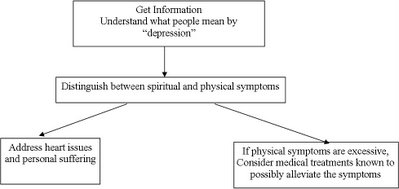
This chart comes from Blame It On The Brain?, Edward T. Welch, page 116.
Very simplistic? Yes. Too simplistic? No. There is much value in being reminded that there is always heart/spiritual roots with mental health problems that must be addressed.

This chart comes from Blame It On The Brain?, Edward T. Welch, page 116.
Very simplistic? Yes. Too simplistic? No. There is much value in being reminded that there is always heart/spiritual roots with mental health problems that must be addressed.
Friday, November 10, 2006
The Experience of Depression
In order to help someone, or yourself, with dealing with depression the experience itself needs to be understood. This is the first step. Makes sense, when someone is dealing with a physical, medical problem, isn't the first step to listen and learn and find out what the person is going through.
When you think about it, depression is a big word. What I mean is that is covers a lot of ground and like I said yesterday, what depression is all about can mean different things to different people. "Don't assume that you understand what someone means by depression. Don't fill the meaning from your own experiences, which may or may not be similar.", Welch, Blame It On The Brain, page 117.
When a depressed person is really listened to, heard for what they alone are experiencing, there will be pain, fear, hopeless, dread, terror, silent screams, and emptiness - all these at a level that threatens to destroy. Physically, the senses are dulled as well. Sounds are muted, colors seem less vibrant. Technically, the DSM-IV defines depression with a little less "feeling" I think. Although helpful for pointing out some symptoms that may not be expressed, the DSM-IV is too clinical and less personal. The DSM-IV definition of depression makes it easier to view depression as a strictly medical condition.
Depression, to be fully understood, needs to be observed and listened to. The experience ranges from one extreme of the desire to die to emotional numbness and feeling like a living death. Sometimes a depressed person experiences both extremes at the same time. What is universal though in all descriptions is "pain", in that it is the most common explanation of what a depressed is going through. It is this feeling of "pain" that bridges the gap between spiritual and physical experiences of depression. The "pain" of depression manifests itself in physical symptoms but mostly it originates on the spiritual side of things. Most secular treatments for depression try to eliminate the physical symptoms and do nothing to heal the spiritual issues.
There has to be then a process to go through so that physical symptoms are distinguished from spiritual symptoms and then both need to be dealt with accordingly. If physical problems are confused with spiritual then the depressed person will be held morally responsible for something physical. Also, if spiritual symptoms are confused with physical then sin could be excused and seen as insignificant, worse yet, this could lead to hopelessness for spiritual growth when someone has a psychiatric diagnosis. The spiritual problems will be easier to attack and seek healing for because they always deal with the heart. The physical symptoms are more difficult to pinpoint but the process has become a bit more manageable.
When you think about it, depression is a big word. What I mean is that is covers a lot of ground and like I said yesterday, what depression is all about can mean different things to different people. "Don't assume that you understand what someone means by depression. Don't fill the meaning from your own experiences, which may or may not be similar.", Welch, Blame It On The Brain, page 117.
When a depressed person is really listened to, heard for what they alone are experiencing, there will be pain, fear, hopeless, dread, terror, silent screams, and emptiness - all these at a level that threatens to destroy. Physically, the senses are dulled as well. Sounds are muted, colors seem less vibrant. Technically, the DSM-IV defines depression with a little less "feeling" I think. Although helpful for pointing out some symptoms that may not be expressed, the DSM-IV is too clinical and less personal. The DSM-IV definition of depression makes it easier to view depression as a strictly medical condition.
Depression, to be fully understood, needs to be observed and listened to. The experience ranges from one extreme of the desire to die to emotional numbness and feeling like a living death. Sometimes a depressed person experiences both extremes at the same time. What is universal though in all descriptions is "pain", in that it is the most common explanation of what a depressed is going through. It is this feeling of "pain" that bridges the gap between spiritual and physical experiences of depression. The "pain" of depression manifests itself in physical symptoms but mostly it originates on the spiritual side of things. Most secular treatments for depression try to eliminate the physical symptoms and do nothing to heal the spiritual issues.
There has to be then a process to go through so that physical symptoms are distinguished from spiritual symptoms and then both need to be dealt with accordingly. If physical problems are confused with spiritual then the depressed person will be held morally responsible for something physical. Also, if spiritual symptoms are confused with physical then sin could be excused and seen as insignificant, worse yet, this could lead to hopelessness for spiritual growth when someone has a psychiatric diagnosis. The spiritual problems will be easier to attack and seek healing for because they always deal with the heart. The physical symptoms are more difficult to pinpoint but the process has become a bit more manageable.
Thursday, November 09, 2006
Depression
Depression is HELL! Literally, living with depression is painful and like living in a box contained by all your worst fears, horrors, anxieties all swirling around crying out for attention. Depression can squash a person's will to live - hope does not seem real. The most caring and dedicated people can be incapacitated and absolutely trapped in a prison of hellish depression and seeming so unable to change and "pull themselves out of it." Not all the time but sometimes depression seems so resistant to change. Depression itself breeds hopelessness.
Millions of people suffer from depression. Some describe depression like I did in the above paragraph. Some know when they are depressed. Some can accurately diagnose their own condition, it is either a good day or a bad day. Some are not so sure. Some have a feeling something is wrong but can put their finger on it.
The point is, the depression experience itself can mean different things to different people. I really don't think anyone knows exactly how any particular depressed person is feeling. No one knows for sure because there are so many descriptions of what depression is like to live with.
For the next few posts I want to move into practical application in dealing with mental health issues. Up to this point I've stated my belief that there is always a spiritual component in the complexity of mental health problems - always! Contrary to the conclusions of brain science research, psychiatric problems are not one hundred percent physical and related to chemicals only. Although there is a physical element involved, solutions to mental health problems should not be one hundred precent medication based (which only deal with the physical.) People with mental health issues can be renewed by faith in the midst of pain and trials.
So, in the treatment of psychiatric disorders both the spiritual and physical need to be dealt with. But what do I know? What do I have to say about treatments of psychiatric disorders...I am not a Doctor much less a professional!? What counsel could I possibly offer to anyone suffering from mental illness? What about you? What business do you have in helping that friend or co-worker who is depressed?
I do believe there is very practical help most caring people can provide others in dealing with mental health issues. The help comes in the form of listening and assisting the suffering while they describe their suffering and then helping them distinquish between heart issues from physical issues. Heart issues will be uncovered and so those can be tackled one by one, physical symptoms will be more clearly identified and thus easier to deal with.
I realize this is over simplification. Mental health issues are complex!!! But, if not reduced to just matter and physical causes only, there is much help a good friend can provide a suffering person - when the soul is brought back into the equation, friends can help friends, soul to soul.
Millions of people suffer from depression. Some describe depression like I did in the above paragraph. Some know when they are depressed. Some can accurately diagnose their own condition, it is either a good day or a bad day. Some are not so sure. Some have a feeling something is wrong but can put their finger on it.
The point is, the depression experience itself can mean different things to different people. I really don't think anyone knows exactly how any particular depressed person is feeling. No one knows for sure because there are so many descriptions of what depression is like to live with.
For the next few posts I want to move into practical application in dealing with mental health issues. Up to this point I've stated my belief that there is always a spiritual component in the complexity of mental health problems - always! Contrary to the conclusions of brain science research, psychiatric problems are not one hundred percent physical and related to chemicals only. Although there is a physical element involved, solutions to mental health problems should not be one hundred precent medication based (which only deal with the physical.) People with mental health issues can be renewed by faith in the midst of pain and trials.
So, in the treatment of psychiatric disorders both the spiritual and physical need to be dealt with. But what do I know? What do I have to say about treatments of psychiatric disorders...I am not a Doctor much less a professional!? What counsel could I possibly offer to anyone suffering from mental illness? What about you? What business do you have in helping that friend or co-worker who is depressed?
I do believe there is very practical help most caring people can provide others in dealing with mental health issues. The help comes in the form of listening and assisting the suffering while they describe their suffering and then helping them distinquish between heart issues from physical issues. Heart issues will be uncovered and so those can be tackled one by one, physical symptoms will be more clearly identified and thus easier to deal with.
I realize this is over simplification. Mental health issues are complex!!! But, if not reduced to just matter and physical causes only, there is much help a good friend can provide a suffering person - when the soul is brought back into the equation, friends can help friends, soul to soul.
Subscribe to:
Posts (Atom)